

Variable-Compression Multi-Fuel Generation:
Addressing Power Derating and Generator Sizing in Petrol, LPG, and Natural Gas Operation
Introduction
Dual-fuel and tri-fuel generators are increasingly attractive in applications where fuel flexibility is operationally important rather than merely convenient. In many real-world settings, operators want the ability to run on petrol, propane (LPG), or methane (natural gas) depending on fuel availability, storage constraints, runtime requirements, emissions considerations, or site safety.
However, conventional dual- and tri-fuel generator sets typically rely on engines originally optimized for petrol operation. When these fixed-compression engines are run on gaseous fuels such as LPG or natural gas, they often experience a reduction in available power output. This creates a practical engineering problem during specification and procurement: which fuel should determine the generator’s rated size?
This article examines the origin of that derating effect, the sizing dilemma it creates, and how a software-controlled crankshaft architecture, such as that proposed in the Galin generator concept, may address the issue.
Why Conventional Multi-Fuel Generators Lose Power on LPG and Methane
Conventional small and medium generator engines are based on a fixed mechanical geometry. Their compression ratio, piston motion, and combustion chamber characteristics are set by hardware and cannot be adjusted dynamically to match the fuel being used.
That fixed design is usually a compromise centred around petrol. Petrol engines are commonly designed with compression ratios in a range suitable for avoiding knock while maintaining acceptable performance and durability. By contrast, LPG and methane have different combustion properties and can tolerate, and often benefit from, different compression and combustion settings.
As a result, when a conventional petrol-optimised generator is operated on gaseous fuels:
LPG typically produces somewhat lower peak output than petrol
Methane/natural gas typically produces a larger output reduction
the exact derating depends on engine design, air-fuel mixing, ignition timing, volumetric efficiency, and control strategy
In practical generator markets, output reductions on the order of ~15% on LPG and ~25% on methane are commonly used as illustrative figures for conventional systems. The exact value will vary by platform, but the directional issue is well understood: a fixed engine optimised around petrol generally does not deliver equivalent rated output across all fuels.
This is not only a combustion issue. In gaseous operation, performance may also be affected by:
lower volumetric energy density of the inducted charge
fuel metering limitations
ignition timing compromises
combustion speed differences
emissions and thermal management constraints
For the end user, the important point is simple: the same generator nameplate does not always imply the same usable electrical output across fuels.
Figure 1 shows the comparative power output profiles of a generator running on petrol, LPG, and methane under two different architectures:
Conventional fixed-compression generator
Optimised software-crankshaft generator
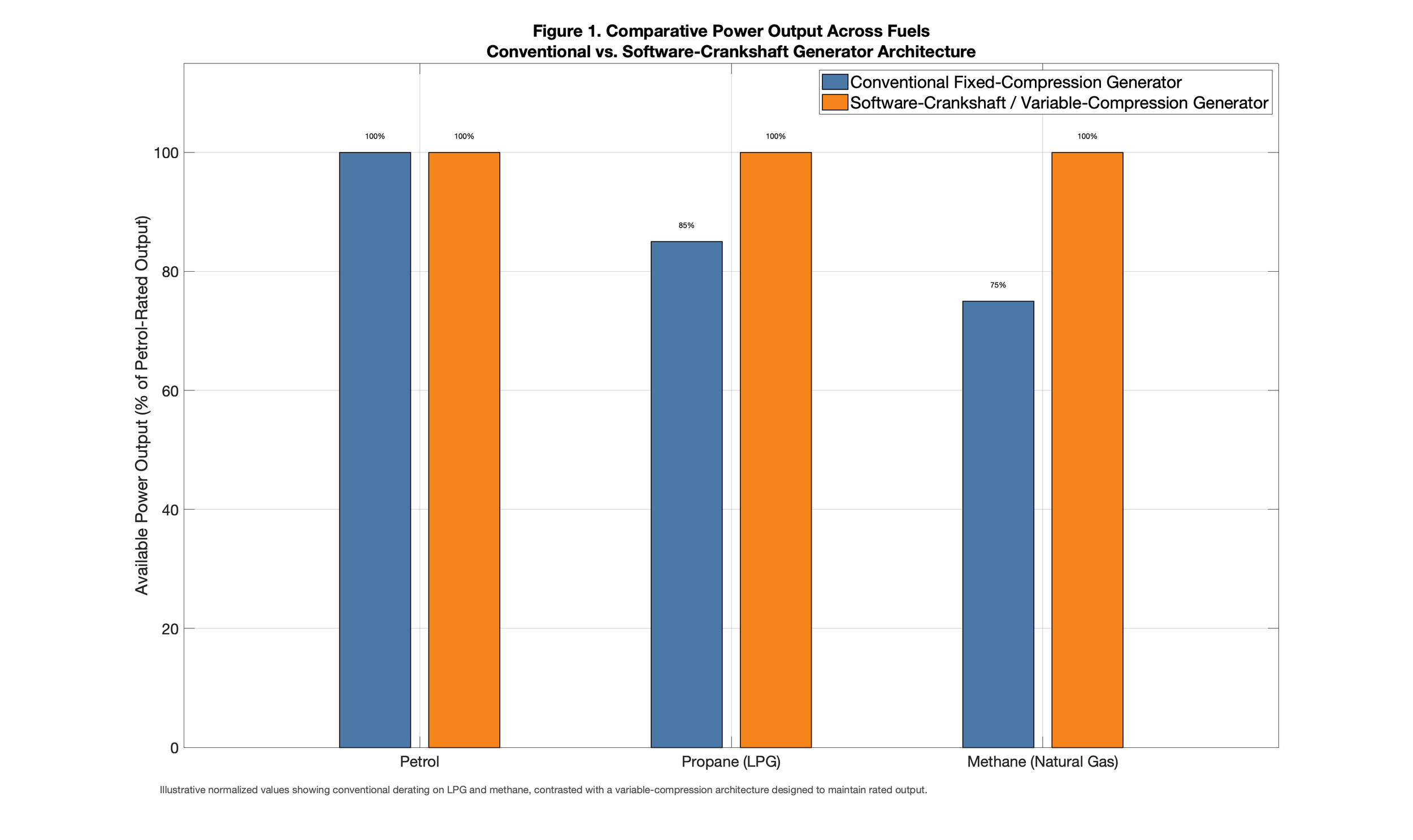
Figure 1 compares the power output profile of a conventional fixed-compression generator with that of an optimised software-crankshaft generator operating on petrol, LPG, and methane.
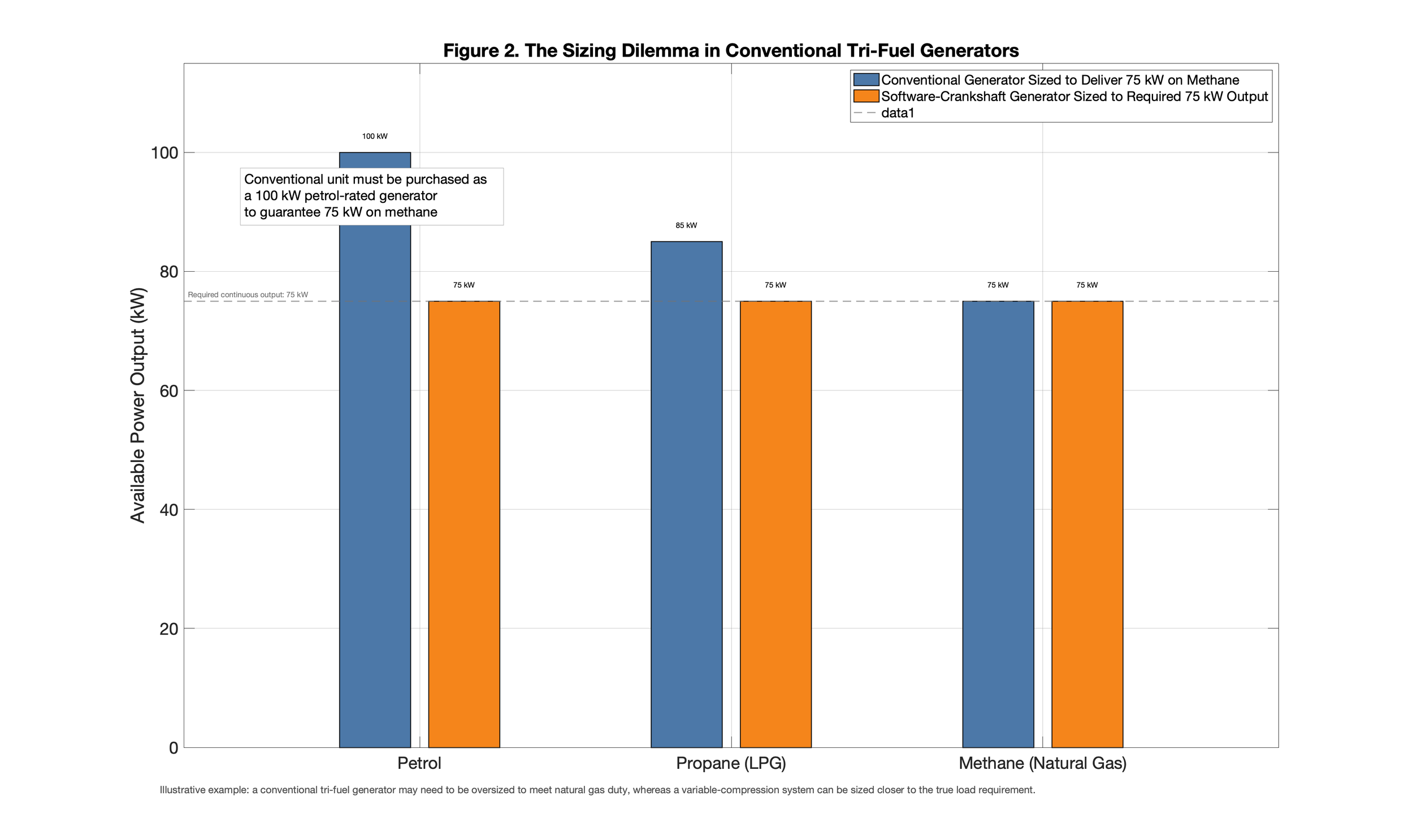
Figure 2. To guarantee 75 kW continuous output on methane, a conventional generator with an approximate 25% methane derating may need to be specified as a 100 kW petrol-rated unit, creating excess capacity on petrol and LPG. A software-crankshaft generator avoids this mismatch by maintaining a more consistent output across fuels.
The Generator Sizing Problem
The practical consequence of fuel-dependent derating is not merely reduced performance. It directly affects how the generator must be sized. If the buyer expects the generator to operate on all three fuels, then the purchase decision must account for the fact that the lowest-output fuel determines the minimum guaranteed capacity.
In a conventional tri-fuel system, methane is often the limiting case. If methane operation reduces available power by around 25%, then a generator intended to guarantee a given output on natural gas must be oversized relative to its petrol rating.
For example, illustrated in figure 2:
required continuous electrical output on methane: 75 kW
conventional methane derating: 25%
required petrol-rated generator size: 100 kW
This means the generator is physically purchased and installed as a 100 kW machine in order to ensure only 75 kW when operating on methane.
Why Oversizing Creates Operational Problems
Oversizing is often treated as a harmless safety margin, but in practice it creates several penalties. When the generator is sized around methane performance, then under petrol operation the machine may be larger than required for the actual electrical load. That can lead to:
operation at lower relative load
poorer fuel economy at part load
less efficient engine utilization
potentially higher specific fuel consumption
greater capital cost
larger installation footprint
unnecessary weight and packaging penalties
So the sizing decision becomes a compromise between:
ensuring enough output on methane, and
avoiding inefficient oversizing on petrol.
How a Software-Crankshaft System Changes the Design Constraint
A software-crankshaft architecture seeks to remove the fixed-geometry compromise that defines conventional multi-fuel engines. Rather than keeping the same compression and combustion geometry regardless of fuel, such a system adjusts engine operating characteristics to better match petrol, LPG, or methane as the fuel changes. In principle, this allows the engine to operate closer to the compression and combustion conditions best suited to each fuel. Implemented effectively, the expected result is:
reduced derating on gaseous fuels
more consistent torque and power across fuels
less need to oversize for natural gas operation
a simpler generator selection process
improved utilisation of the installed machine
In the case of the Galin generator, the central proposition is that software-controlled engine geometry or software-crankshaft behaviour allows the engine to adapt to the fuel, rather than accepting the conventional compromise of one fixed mechanical setting for all fuels.
Where Tri-Fuel and Dual-Fuel Capability Is a Need, Not a Luxury
The strongest markets for this kind of generator are not simply those that appreciate optionality. They are markets where fuel uncertainty, resilience, and continuity of operation make multi-fuel capability operationally necessary.
1. Backup power for critical infrastructure: Facilities such as telecom towers, data relay nodes, water and wastewater stations, emergency communications systems, healthcare support infrastructure, municipal resilience assets, often cannot tolerate long outages. In these applications, the ability to switch between stored liquid fuel and piped gas can be essential when one fuel supply is disrupted.
2. Disaster-prone and grid-unstable regions: In areas exposed to hurricanes, wildfires, floods, extreme winter events, prolonged grid instability, fuel logistics often become the limiting factor after the initial outage. Petrol may be available in one phase of the event, LPG in another, and piped natural gas in yet another. A generator that can use multiple fuels without a major output penalty has clear resilience value.
3. Remote industrial and off-grid sites: Mining sites, field operations, remote compounds, agricultural processing sites, and isolated commercial operations often face changing fuel availability and high logistics costs. In these environments, dual- and tri-fuel capability can reduce operational risk and improve continuity.
4. Residential and commercial standby systems in gas-served areas: For buildings with natural gas service but a need for backup liquid fuel storage, tri-fuel operation is not just convenient. It can be critical when one fuel path is interrupted or when runtime requirements exceed stored fuel inventory.
5. Military, civil defence, and emergency response applications: These users value systems that can run on whatever fuel is available in disrupted or contested environments. In such contexts, flexibility is directly tied to mission continuity.
6. Transitional energy markets: In regions moving between diesel/petrol dependence and broader gas adoption, multi-fuel generators can bridge infrastructure gaps. Here, the ability to maintain reliable output across changing fuel options can support both resilience and operational planning.
In all of these segments, the key point is the same: fuel flexibility only becomes fully valuable when the generator can deliver predictable output across those fuels. If the user still has to derate heavily or oversize the machine, much of the practical value is lost.
Conclusion
For operators in resilience-critical applications, the issue is not simply fuel flexibility, but whether that flexibility comes with a power penalty. A software-crankshaft architecture is compelling because it seeks to remove that penalty at the engine level, enabling more consistent output, simpler sizing, and better utilisation across petrol, LPG, and methane.